
10 Essential Italian Words for the Driving Theory Exam
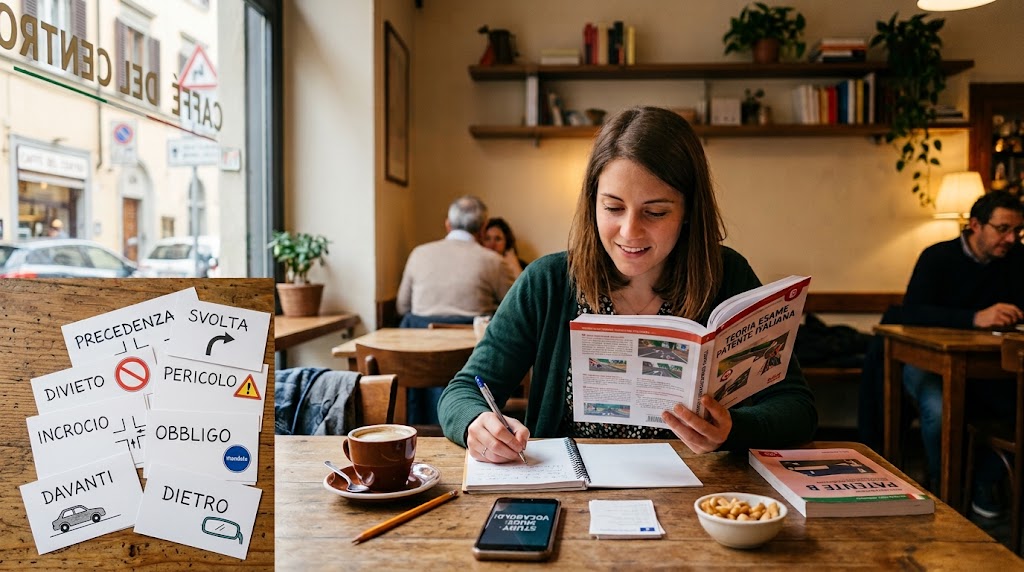
Preparing for the Italian driving license (Patente B) theory exam can feel overwhelming, especially when navigating technical Italian terminology. Mastering these 10 core words—along with how they appear in official quiz questions (schede)—will help you avoid common trick questions and build confidence.
1. Strada (Road)
- What it means: The entire road area open to the movement of pedestrians, animals, and vehicles (including sidewalks, bike lanes, and shoulders).
- Key Quiz Distinction: A strada is not the same as a carreggiata (the carriageway where vehicles drive). A strada contains the carreggiata.
- Exam Example:
«La strada può essere a senso unico o a doppio senso di circolazione.» (The road can be one-way or two-way.) — VERO (True)
2. Destra (Right)
- What it means: Right (direction or side).
- Key Quiz Distinction: In Italy, general priority rules dictate yielding to the right (dare la precedenza a destra) unless road signs indicate otherwise.
- Exam Example:
«Di norma, negli incroci bisogna dare la precedenza ai veicoli provenienti da destra.» (Normally, at intersections, you must give priority to vehicles coming from the right.) — VERO (True)
3. Sinistra (Left)
- What it means: Left (direction or side).
- Key Quiz Distinction: Crucial for questions regarding lane positioning (corsia di sinistra for overtaking on multi-lane roads) and turning maneuvers.
- Exam Example:
«Per svoltare a sinistra, bisogna avvicinarsi all'asse della carreggiata nelle strade a doppio senso.» (To turn left, you must approach the center line of the carriageway on two-way roads.) — VERO (True)
4. Davanti / Anteriore (In front / Front)
- What it means: Situated in front or referring to the front of a vehicle.
- Key Quiz Distinction: The quiz frequently alternates between everyday words like davanti and technical terms like anteriore (e.g., luci anteriori = front lights).
- Exam Example:
«La distanza di sicurezza deve essere mantenuta rispetto al veicolo che si trova davanti.» (Safety distance must be maintained with respect to the vehicle in front.) — VERO (True)
5. Dietro / Posteriore (Behind / Rear)
- What it means: Behind or situated at the rear of a vehicle.
- Key Quiz Distinction: Crucial when assessing mirror checks, reversing (retromarcia), or rear fog lights (fendinebbia posteriori).
- Exam Example:
«Prima di iniziare la manovra di retromarcia, occorre controllare che non vi siano ostacoli dietro al veicolo.» (Before reversing, you must check that there are no obstacles behind the vehicle.) — VERO (True)
6. Incrocio / Intersezione (Intersection)
- What it means: A junction where two or more roads cross at the same level (a raso) or different levels (a livelli sfalsati).
- Key Quiz Distinction: You must recognize whether the question refers to an uncontrolled intersection (senza segnali) or one regulated by traffic lights/signs.
- Exam Example:
«In un incrocio regolato da semaforo, la luce gialla fissa obbliga a fermarsi se ciò può essere fatto in sicurezza.» (At an intersection controlled by traffic lights, a solid yellow light requires stopping if it can be done safely.) — VERO (True)
7. Svolta (Turn / Turning Maneuver)
- What it means: Changing direction to another road to the left or right.
- Key Quiz Distinction: Do not confuse svolta (turning onto a new road) with cambio di corsia (changing lanes on the same road) or inversione di marcia (U-turn).
- Exam Example:
«Prima di effettuare una svolta, è obbligatorio segnalare la manovra in anticipo con gli indicatori di direzione.» (Before turning, it is mandatory to signal the maneuver in advance using turn signals.) — VERO (True)
8. Divieto (Prohibition)
- What it means: A restriction or ban on a specific action, vehicle type, or maneuver.
- Key Quiz Distinction: Regulatory signs with circular shapes and red borders typically indicate prohibitions (e.g., divieto di sosta, divieto di sorpasso).
- Exam Example:
«Il segnale di divieto di sorpasso vieta di superare i veicoli a motore a due ruote se non invadono la corsia opposta.» (The no-overtaking sign prohibits overtaking two-wheeled motor vehicles if you don't cross into the opposite lane.) — FALSO (False)
9. Obbligo (Obligation / Mandatory)
- What it means: An action or direction that road users are legally required to follow.
- Key Quiz Distinction: Obligation signs are circular with a blue background and white symbols (e.g., direzione obbligatoria, limite minimo di velocità).
- Exam Example:
«I segnali di obbligo impongono un comportamento specifico da seguire immediatamente dopo il segnale.» (Obligation signs require a specific behavior to be followed immediately after the sign.) — VERO (True)
10. Pericolo (Danger / Hazard ⚠️)
- What it means: A warning about potential roadway hazards, changing road conditions, or obstacles ahead.
- Key Quiz Distinction: Danger warning signs are triangular with a red border pointing upwards and are typically placed 150 meters before the actual hazard.
- Exam Example:
«I segnali di pericolo sono posti di norma a 150 metri dal punto in cui inizia il pericolo.» (Danger signs are usually placed 150 meters before the point where the hazard begins.) — VERO (True)
Quick Study Tip for the Exam 💡
Pay special attention to absolute words in Italian questions, such as:
- Sempre (Always) — Often makes a statement False.
- Mai (Never) — Often makes a statement False.
- Solo / Esclusivamente (Only / Exclusively) — Often used in false trap statements.
Bookmark this guide and review these definitions regularly while practicing official quizzes! 🇮🇹